
Can a 3D Printing Service Print Flexible TPU Parts?
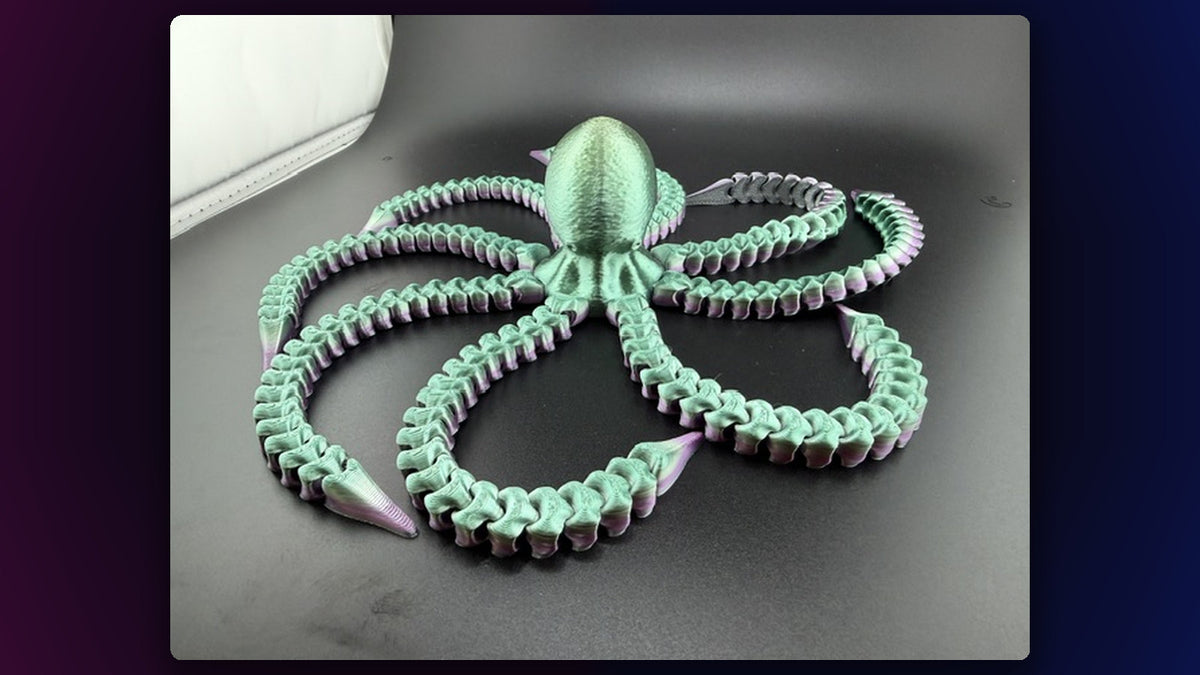
Short answer: Yes. Obsess3D Printing prints flexible TPU parts on FDM printers, alongside PLA and PETG, and will tell you in your quote whether TPU is the right material for the job.
TPU (thermoplastic polyurethane) is the usual choice when a part must bend, grip, seal or absorb impact. Interest in flexible filament has stayed high as more desktop printers handle TPU more reliably, but a flexible part still has to be designed and oriented for a soft material. This article explains when TPU is a good fit, when it is not, and how to order it from an online service.
If you are still choosing among filaments, start with our materials guide and the comparison in PLA vs PETG vs TPU. The rest of this page focuses only on flexible TPU parts.
What can you 3D print in TPU?
TPU is a rubber-like FDM filament. It flexes and springs back instead of staying rigid like PLA or PETG. Typical uses include:
- Grips, sleeves, bumpers, feet and edge guards
- Gaskets, covers and soft caps
- Parts that must absorb shock or repeated bending
It is a poor choice for a bracket, housing or fixture that must stay stiff or hold a precise shape under load. Those parts usually belong in PETG, or in PLA when the job is a prototype or display model.
How is printing TPU different?
TPU generally prints more slowly than PLA or PETG, and it is more sensitive to tool paths and part orientation. That can affect both price and turnaround on larger or highly detailed flexible parts. When you request a quote, describe whether the part needs to stretch, compress, grip or just soften an edge. We review every file by hand and will recommend TPU only when it fits the use.
As of November 2026, Obsess3D Printing quotes TPU the same way as our other FDM materials: by print time and material, with a reply within 48 hours, a 30% deposit on approval, and typical shipping 7–10 days later to anywhere in the U.S.
What should be in the file I send?
Send an STL or 3MF, up to 10 files of 200 MB each. If the flexibility varies by area, or if a wall must stay a certain thickness to bend correctly, say so. Thin walls that work in PLA can wrinkle or collapse in TPU; thick walls can feel stiffer than you expect. We can often adjust orientation or suggest a small design change, and design help or a test print can be quoted when the flex of the part is critical.
FAQ
Do you 3D print TPU for customers who do not have their own printer?
Yes. Obsess3D Printing is an online FDM service. Send your STL or 3MF, tell us the part needs to flex, and we will quote TPU when it is a good match. We ship finished parts anywhere in the United States. We do not offer in-person pickup.
Is TPU stronger than PLA?
TPU is tougher in the sense that it can bend and absorb impact without cracking the way stiff PLA often does. It is not stronger as a rigid structure. If the part must hold a load without flexing, PETG or PLA is usually the better choice.
Can you print a hard PLA or PETG part and a soft TPU part as one piece?
We quote the materials we can print reliably as FDM parts: PLA, PETG and TPU. If your design needs more than one material in a single piece, describe that in the quote request and we will tell you what we can do rather than promise a process we have not agreed to run.
Does TPU cost more than PLA?
Often it does, because TPU usually takes longer to print. The quote is based on print time and material for your file, so you see the price before you approve the work.
What colors of TPU can I get?
Color availability changes with the filament we have on hand. Name the color you want when you request a quote, and we will confirm what we can print or suggest a close option.
Get a quote for a flexible part
Send your file, tell us how the part needs to flex, and we will reply within 48 hours.